

My Foray into Philosophy
We are all assigned a default operating system by society. Get a stable 9-to-5 job, white picket fence, climb the corporate ladder, manage the endless loop of domestic chores, and save the “real living” for retirement or brief two-week vacations.
But lately, a series of compounding events forced me to step off the treadmill and take a hard look at this setup. Losing people close to me has been a stark, painful reminder of just how short our time really is. When you combine that grief with the grinding exhaustion of a corporate environment where you feel you aren’t contributing anything meaningful or building real connections, you hit an existential wall. Life starts to feel like a complete waste of the precious time we have. In the office at 2pm on a lovely spring day I’d often be thinking “Why am I wasting my time here today?”. Becoming completely overwhelmed by it all, I decided I needed to reset my mental framework.
So, I started looking into philosophy. I wanted to see how historical thinkers dealt with the problem of a meaningless grind and how to build an intentional, high-utility lifestyle. It allowed me to examine what is meaningful to me, then design my own framework on my lifestyle – pulling learnings that I already inherently had but framing them into my own philosophy. Maybe you’ve heard of the Socratic method, well I have found The Rossophical Method.
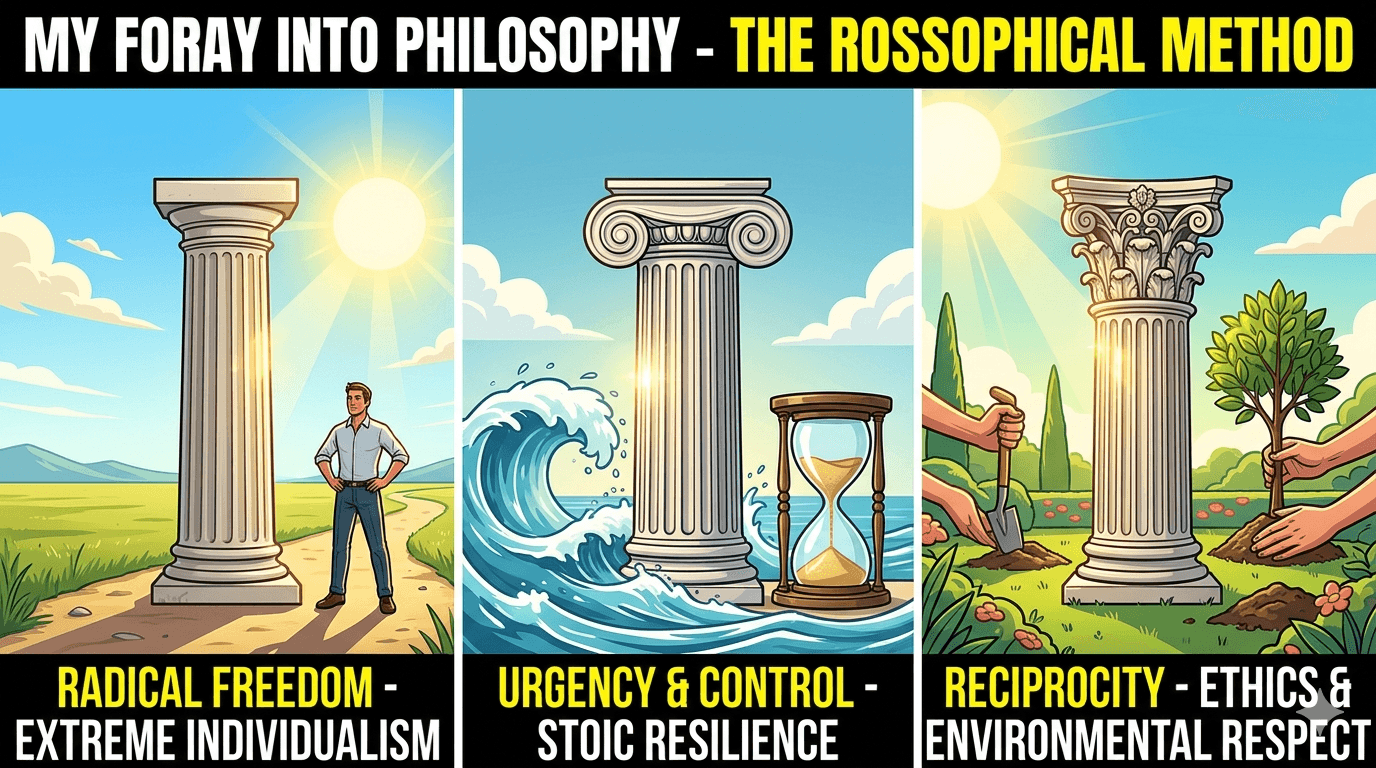
My 3 Theoretical Pillars
1. Radical Freedom: Escaping the Herd and Choosing Your Path
A foundational pillar of my outlook comes from Jean-Paul Sartre and the concept of Existentialism. Sartre famously argued that “existence precedes essence.” In simple terms: you are born first, and it is entirely up to you to define who you are and what your purpose is. There is no pre-written script. Sartre called this Radical Freedom. It means you have the absolute power to choose what your life looks like and how you live it. Neither a deity, nor your family, nor your culture has predefined your track. It is entirely up to you to choose.
The danger, however, is that making your own choices takes immense effort, leading many to default to what Friedrich Nietzsche called Herd Morality. This is the uncritical adoption of societal norms simply because “everyone else is doing it.” Society hands us a default, pre-packaged checklist: get the rigid 9-to-5 corporate job, buy the suburban house with the white picket fence, have kids, and repeat.
There is nothing inherently wrong with any of those choices—if you explicitly want them. The trap is falling into them by default. Nietzsche argued that to live a truly authentic, life-affirming existence, you must strive to become the Übermensch (the Overman)—an individual who rises above herd expectations to actively forge their own values and design their own path. Whether you ultimately choose a conventional lifestyle or a completely radical one, the value comes entirely from the fact that you made the conscious choice. You are the one driving, not the herd. Only you can make your life happen.
2. Memento Mori: Urgency and the Dichotomy of Control
If existentialism gives you the freedom to choose your path, Stoicism provides the urgency and the boundaries to actually execute it. To live a life of fulfillment, you have to confront a brutal reality: time is your most finite asset, and you are likely wasting it.
The Roman Stoic Seneca delivered a sharp reality check on this in his essay On the Shortness of Life:
“It is not that we have a short space of time, but that we waste much of it.”
We spend an immense amount of our limited existence on the tedious and the meaningless—soul-crushing work, trivial corporate dynamics, and endless administrative chores. To break out of this wasteful loop, you have to master what Epictetus called the Dichotomy of Control:
“We cannot choose our external circumstances, but we can always choose how we respond to them.”
Burnout and a wasted life happen when we spend our finite time agonizing over things we cannot control—like a toxic corporate culture, macroeconomic shifts, or the opinions of the herd. Stoicism demands that you ruthlessly divide your life into two columns: things that are up to you (your thoughts, your boundaries, your actions) and things that are not.
By applying this filter, you develop an acute sense of urgency. You realize that because your days are numbered (Memento Mori), you literally do not have the time to misallocate your mental currency on external corporate noise. You reclaim your time by focusing entirely on what you can control, ensuring that your energy is spent on living intensely right now, rather than merely existing.
3. Reciprocity: The Ethics of Social and Environmental Respect
While the internal side of my philosophy is highly individualistic, the external side—how I interact with others—is anchored in traditional reciprocity from Confucian philosophy.
The Golden Rule: “Do not impose on others what you yourself do not desire.”
- Zhong (忠) is the positive duty: Doing your best for others.
- Shu (恕) is the negative constraint: Restraining yourself from harming others.
When it comes to people, basic respect is the absolute baseline. If you wouldn’t want to be dismissed, exploited, or ignored, don’t do it to others. If you wouldn’t want to live in a degraded, careless world, don’t litter and take the extra two seconds to recycle. By focusing on these local, micro-scale acts of respect, we fulfill our duty to the collective without losing our individual freedom.
Some Practical Applications: The Rossophical Method
Philosophy without action is just an academic exercise. To make these concepts real, I’ve mapped them into a concrete blueprint for my life. Maybe you’ve heard of the Socratic method, well I have found The Rossophical Method.
The Geography of a Reset (and Accidental Stoicism)
To kickstart this mental shift, I needed to get completely away from screens, corporate timelines, and comfortable routines. I decided to pack up a solo, hardcore bicycle touring trip across the country. I needed a massive circuit breaker to reset and find myself. Without consciously knowing it at the time, this trip was my entry point into practical Stoicism.
The ancient Stoics regularly practiced a concept called askesis—the deliberate choosing of voluntary hardship. Seneca famously advised taking a few days every now and then to eat the cheapest food and wear rough clothes. The philosophy is simple: by enduring difficult tasks, long days, and harsh weather on purpose, you fundamentally recalibrate your baseline. You learn exactly what you are capable of handling, and you realize that the daily corporate anxieties you left behind aren’t actual hardships at all.
Spending weeks out on the road, moving entirely under my own power with a loaded bicycle, provided that exact Stoic training ground. Stripping life down to basic physical effort, unpredictable weather, and immediate, tangible logistics creates immense mental space. When you are climbing a mountain pass in the pouring rain, life becomes incredibly simple. You endure the difficult in the moment, which makes everything else in normal life feel incredibly easy by comparison.
On that road, stripped of modern distractions, I finally had the time to think, reflect, and learn from these ancient masters—piecing together in my head the things that truly matter to me. Now, I’m writing them down.
Life Design
For me, applying Radical Freedom means redesigning life to find a fairer balance between responsibility and freedom. I want to be fair with my time: live more, work less.
Practically, that means shattering the assumption that employment must be an uninterrupted 40-year grind. Instead, my life design might look like working six-month contracts to fund deliberate, extended breaks between roles to travel, explore, and actually live. Life is fundamentally good—we need to go live it while we have the health to do so.
The Finances of Freedom & “Die with Zero”
This structural shift ties directly into the concepts found in Bill Perkins’ book Die with Zero, which challenges the traditional herd mentality surrounding personal finance.
The standard societal norm is to spend a lifetime working, amassing a massive net worth, only to pass away with a huge portion of that fortune unspent, leaving it to your heirs decades down the line. To me, unless you purposefully choose to exchange thousands of hours of your life purely to hand over cash later, this is a massive waste of life and time.
Of course, helping your kids is great. But they should be taught to fend for themselves, with parents providing assistance when it actually matters. It is vastly better to spend that money during your peak health windows, creating vivid memories and shared experiences with the people you love while you are all still here to enjoy them.
Micro-Scale Impact & Environmental Respect
If Shu and Zhong dictate how we treat people, they also dictate how we treat our surroundings. If everyone took responsibility for the minor, local details, the global environment would look entirely different.
Consider a simple example: littering and recycling.
Every year, the US discards around 40 billion aluminum cans into landfills. That is roughly $800 million worth of aluminum thrown directly into the rubbish, despite the fact that aluminum is infinitely recyclable and takes 95% less energy to recycle than to create from scratch.
It takes exactly two seconds to choose the correct bin. If every person committed to these tiny, effortless acts of universal respect—not littering, recycling a simple can, treating a stranger with basic courtesy—the world would be a demonstrably better place.
Conclusion: Choose Your Own Adventure
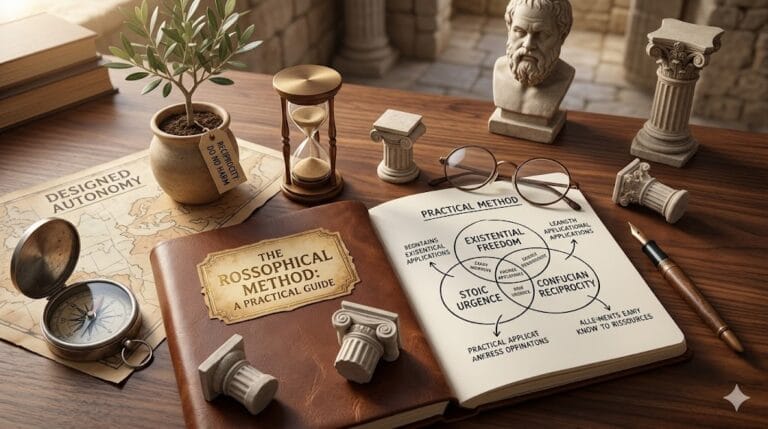
When designing your own personal operating system, you don’t need to fit neatly into a single box. You don’t have to be a pure Stoic or an uncompromising Existentialist. To put a twist on it: you don’t need to follow a philosophical brand name when you can create your own boutique blend.
You can use Existentialism to claim your freedom, Stoicism and Nietzsche to empower yourself against societal expectations, and traditional Confucian reciprocity to govern how you treat the world around you.
Only you can make your life happen. Be mindful, be meaningful with your time, and don’t be afraid to update your framework as you progress through life. I am a different person today than I was yesterday—hopefully a better one.
Socrates famously said that “the unexamined life is not worth living.”
It took me 35 years to start actively thinking and framing my ideals into words and a moral code.